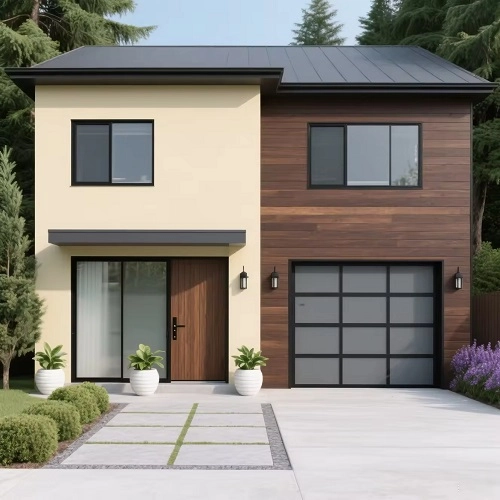
"Is a prefab house really reliable?" This is probably the most common question asked by every potential homeowner considering a prefabricated building.
Many people hear the word "prefab" and picture temporary site cabins—but those are temporary structures, not the subject of this article. A true prefab home is a permanent building whose components are manufactured on standardized production lines in a factory and then transported to the site for assembly. Its structural parts are like factory products—quality and dimensions are fully controlled.
So, which is better—prefab homes or traditionally built homes?
Traditional construction: The house is built entirely on the final site, piece by piece—brick by brick, board by board. The entire process is exposed to the elements, constrained by weather, material availability, and worker schedules.
Prefab homes: a broad term encompassing several types, the most prominent of which is modular homes. The individual modules are built in a controlled factory environment, then transported to the site and lifted onto a permanent foundation by crane. They must comply with the same local building codes as site-built homes.
Cost and Time Comparison:
|
Comparison Aspect |
Modern Prefab Homes (Modular) |
Traditional Site‑Built Homes |
|
Design fees |
Lower (using standard templates) |
Higher (custom architect design required) |
|
Material costs |
Lower (bulk purchasing discounts) |
Higher (retail purchasing + on‑site waste) |
|
Labor costs |
Lower (efficient factory assembly line) |
Higher (skilled on‑site craftsmen are scarce) |
|
Construction time (permit to completion) |
Typically 3–6 months |
7–18 months or longer |
Prefab homes: Because they are produced in a controlled factory environment, materials are not exposed to weather, and standardized procedures are strictly enforced. This results in high component precision and excellent structural airtightness. However, transportation and lifting may impose additional stress on joints and seismic connections.
Traditional homes: Build quality is highly dependent on the experience and skill of the on‑site crew. Susceptible to weather delays, and the complexity of on‑site management makes it difficult to maintain the same consistency in material quality across batches as achieved in a factory.
Insulation and energy efficiency: Prefab homes typically come with advanced insulation materials and energy‑efficient windows integrated at the factory. Better airtightness often gives them superior energy performance compared to traditional homes.
Sound insulation: Traditional homes using masonry or solid concrete construction generally offer better overall noise reduction and sound insulation than lightweight steel‑framed or timber‑framed prefab panels.
Durability and service life: Modern permanent modular/prefab homes are typically designed for a service life of 50 to 70 years or more, comparable to well‑built traditional brick or timber homes.
Prefab homes: While modern prefab homes offer a wide range of floor plan options, once the design is finalized at the factory, major modifications are difficult to make later. In some real estate markets, their resale value may be slightly lower than that of comparable traditional homes.
Traditional homes: Offer virtually unlimited design freedom. Owners can expand or remodel at any time after completion, and they generally enjoy higher market acceptance in land and property value assessments.
From an environmental perspective, prefab construction has clear advantages. The precise manufacturing process in a factory generates extremely minimal material waste. The common problem of over-ordering and waste on traditional construction sites is greatly reduced through optimized factory workflows.
In addition, shorter construction time means less energy consumption and disruption at the site. As global attention on the carbon footprint of buildings grows, prefab construction is increasingly recognized as a more sustainable solution.
You want to move in sooner, without waiting over a year
You need a predictable budget without escalating costs during construction
You value energy efficiency and long‑term operating costs
Your design customization needs fall within standard options
Your area faces skilled labor shortages or adverse weather conditions for extended outdoor construction
You desire a highly unique architectural design
You want to participate in every decision throughout the construction process
You are comfortable with a longer timeline and potential cost fluctuations
Your site has special constraints that make standard modules difficult to adapt
Prefab homes and traditional homes are not a matter of "good" versus "bad"—they are a matter of "suitable" versus "not suitable." Both can produce beautiful, durable, and lasting homes. The difference lies in the path you take to get there. Choosing the path that suits your needs is the truly wise decision.