
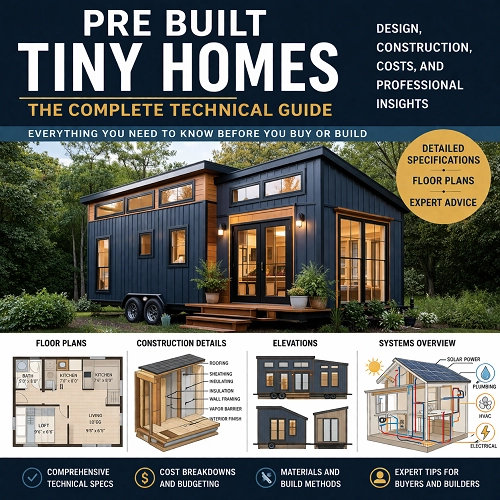
Pre built tiny homes are factory-manufactured, modular housing units that arrive at a site nearly ready for immediate occupancy. Unlike traditional on-site construction — which can span months and involve unpredictable costs — these homes are engineered, assembled, and quality-tested in a controlled factory environment before delivery.
The result is a compact, durable dwelling that can function as a full-time residence, a backyard ADU (accessory dwelling unit), a vacation cabin, a workforce housing unit, or even a commercial pod. Because the bulk of the build happens off-site, lead times drop dramatically and material waste is minimised.
"Affordable, eco-friendly, and beautifully designed — pre built tiny homes make owning a unique and functional space easier than ever."
The structural integrity of any pre built tiny home begins with its frame. Suppliers like FSILON Prefabricated Building offer three principal structural systems, each suited to different climate zones, transport requirements, and load ratings.
Galvanised cold-formed steel sections form a rigid skeleton that is lightweight yet capable of spanning large openings. LSF structures resist termites, fire, and moisture — common failure points in timber construction. FSILON's Light Steel House / Triangle Cabin range uses LSF as the primary structural method, enabling clear-span interiors free of internal load-bearing walls.
ISO 668-compliant steel containers provide a ready-made structural shell rated for stacking up to nine units high. When used as tiny homes they are stripped of non-structural linings, insulated, fitted with openings, and fitted out to residential standard. The Container House / Expansion House line extends conventional box modules with fold-out or bolt-on expansion sections to increase usable floor area without increasing transport width.
Some contemporary tiny homes adopt an integrated monocoque skin — popularised by the Space Capsule / Apple Cabin format — where the outer shell itself carries structural loads. This allows complex curved geometries and excellent aerodynamic performance in high-wind zones, at the cost of reduced on-site modification flexibility.
| Frame Type | Material | Typical Span | Transport Width | Best For |
|---|---|---|---|---|
| Light Steel Frame | G550 galvanised steel | Up to 12 m clear span | Flat-pack, any width | Residential ADU, cabins |
| Container Frame | Corten / mild steel | 2.4 m × 6/12 m module | 2.44 m (standard ISO) | Stacked communities, offices |
| Capsule / Monocoque | Composite panel skin | Single-skin pod, ≤ 6 m | Pod-specific | Glamping, eco-resorts |
Compact floor plans amplify the impact of every watt lost through the building envelope. Effective insulation is therefore not merely a comfort feature — it directly determines heating and cooling costs across the life of the home.
Closed-cell polyurethane or polyisocyanurate boards achieve R-values of R-20 to R-40 per 100 mm, with near-zero vapour permeability.
Mineral wool, recycled denim, and cellulose batts offer lower embodied carbon and improved acoustic performance versus petrochemical foams.
Argon-filled IGUs with low-E coating reduce window U-values to below 1.6 W/m²K, cutting solar heat gain in summer climates.
Colour-bond metal or composite membranes with ≥ 50 mm rigid insulation above the deck eliminate thermal bridging at rafters.
| Component | Minimum Standard | FSILON Specification | Unit |
|---|---|---|---|
| External Wall | R-13 | R-20 (50 mm foam + 38 mm cavity) | R-value (US) / m²K/W |
| Roof Assembly | R-30 | R-38 (metal deck + rigid board) | R-value (US) |
| Floor | R-11 | R-19 (under-slab board) | R-value (US) |
| Glazing (U-value) | ≤ 2.0 W/m²K | ≤ 1.4 W/m²K (low-E argon) | W/m²K |
| Air Leakage | ≤ 7.0 ACH₅₀ | ≤ 3.0 ACH₅₀ | Air changes/hour @ 50 Pa |
One of the defining advantages of factory-built tiny homes is that plumbing, electrical, cabinetry, and floor finishes are installed under quality-controlled conditions before the unit ships. This translates to fewer on-site defects and faster occupancy. FSILON integrates a complete range of prefabricated interior components across its product lines.
| System | Component | Specification / Product Link |
|---|---|---|
| Flooring | SPC rigid-core plank | SPC Flooring — 4 mm wear layer, waterproof core |
| Wall Finish | Integrated wall panel system | Wall Panel — PVC or fibre-cement substrate |
| Ceiling | Suspended tile grid | Suspended Ceiling — mineral fibre or gypsum tiles |
| Storage | Modular kitchen & wardrobe | Cabinet — MDF carcass, soft-close hardware |
| Access | Entry, internal, pocket doors | Door — steel, composite, or timber veneer |
| Plumbing | Kitchen sink, full bathroom | Pre-piped PEX supply / PVC waste |
| Electrical | Wiring, panel, LED lighting | Pre-wired to local code (adaptable) |
Floor area is the primary variable buyers use to compare models. FSILON's pre built tiny homes are grouped into three broad size classes, each with distinct functional profiles.
| Class | Floor Area | Typical Layout | Primary Use |
|---|---|---|---|
| Micro | 18 – 28 m² (194 – 301 sq ft) | Studio + wet room | Solo occupancy, garden pod, short-term let |
| Compact | 28 – 46 m² (301 – 495 sq ft) | 1 bed / open-plan living + bath | Full-time residence, guest house, ADU |
| Standard | 46 – 65 m² (495 – 700 sq ft) | 1–2 bed + living + kitchen + bath | Couple/small family, vacation cabin, rental |
Modern pre built tiny homes are designed from the ground up with environmental responsibility in mind. Lower floor area means less material, less energy to heat and cool, and a smaller land footprint. FSILON publishes its environmental commitments through a dedicated ESG programme covering testing standards, sustainable projects, and ongoing innovation.
Optional off-grid packages extend sustainability beyond the building envelope. Roof-mount solar-ready brackets, rainwater harvesting connections, and grey-water recycling loops are available across most models — allowing buyers to pursue net-zero or fully autonomous operation where grid connections are unavailable or undesired.
| Add-On | Function | Benefit |
|---|---|---|
| Solar panel brackets | Pre-mounted roof attachment points | Plug-and-play PV installation; no roof penetrations |
| HVAC pre-duct | Factory-routed mini-split sleeve | High-efficiency heat pump ready, no re-work |
| Rainwater inlet | Gutter-to-tank connection kit | Reduces mains water demand by up to 40% |
| Smart lighting | LED + occupancy-sensor wiring | Cuts lighting energy use by ~60% vs standard |
| Grey-water loop | Lavatory drain → toilet flush tank | Reduces total water consumption ~30% |
The versatility of pre built tiny homes spans sectors that would not traditionally overlap. View completed deployments across residential, commercial, and engineering contexts in FSILON's Projects portfolio.
| Sector | Deployment Type | Key Driver |
|---|---|---|
| Residential | Backyard ADU, primary residence | Affordability, speed of occupancy |
| Hospitality / Tourism | Glamping pods, eco-resorts, vacation rental | Unique guest experience, low running cost |
| Real Estate Development | Tiny home communities, affordable housing | Rapid deployment, scalable investment |
| Emergency Relief | Disaster response housing, refugee shelter | Rapid logistics, reusability |
| Commercial / Industrial | Site offices, welfare units, security cabins | Relocatability, minimal infrastructure |
| Remote / Off-Grid | Mining camps, research stations | Self-sufficient systems, harsh-climate ratings |
Selecting a pre built tiny home involves more than choosing a floor plan. The following checklist covers the most common oversights identified in the FSILON FAQ and industry guidance.
| # | Check Point | Why It Matters |
|---|---|---|
| 1 | Foundation type | Trailer, pier, or concrete slab — affects permitting, mobility, and resale |
| 2 | Local building code compliance | Some jurisdictions require HUD or IRC code certification |
| 3 | Transport logistics | Width limits, crane access, and driveway gradients affect delivery cost |
| 4 | Utility connection spec | Verify supply voltage, water pressure rating, and waste pipe size |
| 5 | Warranty & after-sales | Structural vs cosmetic warranty periods differ; confirm parts availability |
| 6 | Lead time & export documentation | International buyers require CO, phytosanitary certs, and bill of lading |
About the Manufacturer
With 19 years of research and manufacturing in the prefabricated construction sector, FSILON supplies pre built tiny homes and a complete ecosystem of prefabricated building components to customers across more than 30 countries. The company's production base in Haiyan County, Jiaxing, Zhejiang, China, covers the full product chain — from structural steel fabrication through to interior fit-out systems.
Explore the full product range: Light Steel House · Container House · Space Capsule · Media & Downloads